Why I chose Crate Training for Toilet Training
Out of my 3 dogs, Ralphie, my 15-week-old Working Cocker Spaniel, is showing the most promise in toilet training. With my lower drive Maltipoos, I learnt that: Puppy Pads are awful and here’s why…..
Bertie
With Bertie being my first dog and impulsively bought I was very, very ill prepared. I went down the typical route all first-time dog owners go, Puppy Pads. However and fortunately, I was smart enough not to leave them around the house because this just causes issues with the dog’s patterning behaviour to toilet in a specific spot inside. Instead, I used to put one outside on the decking for him to wee on. In hindsight, this is bloody pointless and overcomplicates it, why didn’t I just take him outside and reward him for a wee instead? Nevertheless, it worked but this didn’t come without its drawbacks. ‘Princess’ Bertie is now stubborn as hell with walking on wet decking and I think this all ties back into the Puppy Pads. Given the pads were always dry, as a puppy, Bertie wasn’t exposed to the wet decking as much as he should have been. Overall, whilst yes it did work and Bertie is completely house trained, I overcomplicated it so much and created a tiny inconvenient habit through it.
Frankie
I called Frankie an ‘absolute wanker’ in my introduction post and for the most part, this’ll explain it. Despite him being at such a high level with his obedience, Frankie still has ‘accidents’ in my house bordering on just straight up naughtiness. I’m desperately trying to solve this and if you yourself have a stubborn older dog struggling to toilet train, come back to this post and I’ll link it when I finally solve the puzzle. So with Frankie, Puppy Pads weren’t an option and I saw the danger with them almost instantly. I used to keep one pad in the crate just to mop up accidents, big mistake. I came home one day and Bertie had dragged it out and chewed it getting bits of the fluff stuck in his nose. Fortunately, Berties’ steadiness and obedience helped me avoid a vet’s journey and he let me pick it out with tweezers. From this day forward I completely abandoned the pads and never looked back. Now, I can admit I made mistakes with Frankie as a puppy. The main mistake was, I tried to bring him up as only a pack member and didn’t give him the individual attention a puppy should get. I’m certain I’m not alone in this and it’s such an easy mistake to make so, here’s a post on how I’m finding the balance between pack integration and individual time with Ralphie, my Working Cocker Spaniel. These mistakes made me quite lazy with Frankie and I became forgetful about letting him out to toilet regularly and since I didn’t routinely crate him, accidents became more common. This isn’t a Frankie problem whatsoever and I think it just highlights how important structure and individual attention and seeing to is with a puppy and what issues it can lead to. I’m working on this every day and I’m struggling but dog training is all about persistence and consistency.
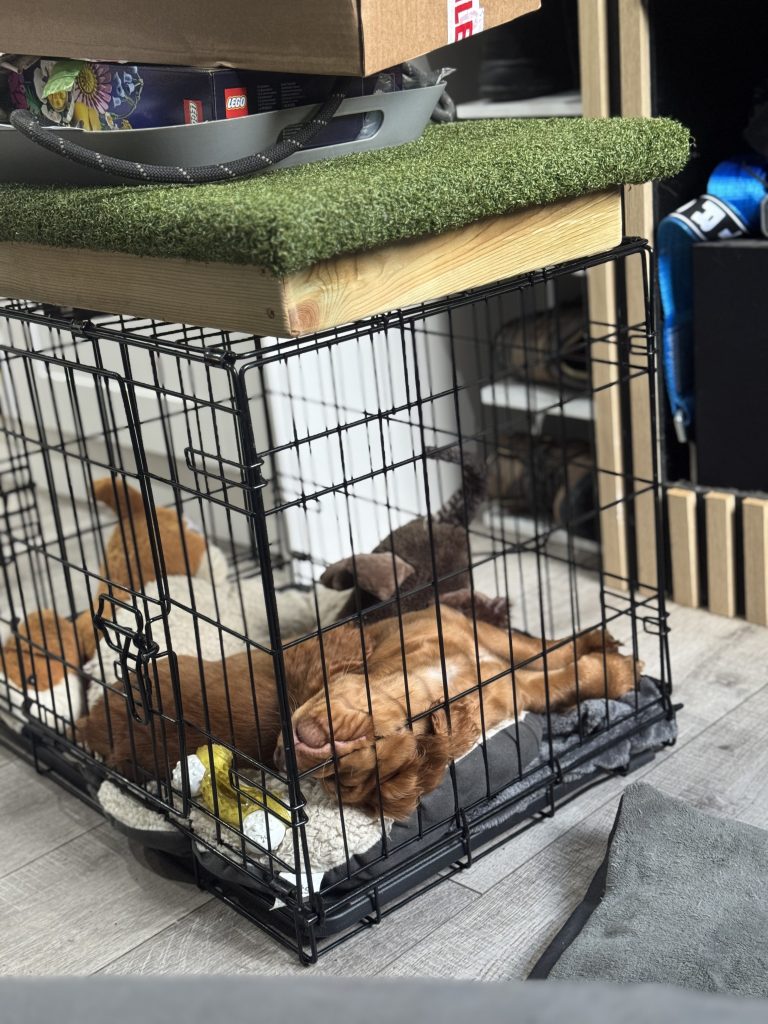
How I’m using the Crate to Toilet Train Ralphie
Back to the present and how I’m fixing my mistakes and overcomplication with my other two dogs. Here’s a quick timeline of how I release puppy from crate and how it’s leading to toilet training:
- Calmly releasing from crate.
- Straight outside to toilet (you should have an idea of if puppy just needs a wee or a poo too eventually)
- Initially go outside with puppy and completely ignore him until he does business.
- When puppy toilets, highly praise but focus on tone and excitement more than actual words and to start, always reward with a treat
- Allow puppy back inside and decide if you want to engage and free roam or just return to crate. Toileting alone shouldn’t lead to automatic freedom. At the end of the day, house training isn’t a ‘special trick’ it’s an expectation and shouldn’t be rewarded like your puppy has just solved the Enigma code
Let’s break it down some more. The calm release is outlined in my Crate Neutrality post so I’ll brush past this part here. Onto letting the puppy outside. You need to remember that as a 8-week-old puppy, they purely act on impulse and have very little sustained engagement. Therefore, for the first few weeks I always picked Ralphie up and placed him outside to drill the routine that he goes straight out every time without giving him time to get distracted and risk accidents. As puppy became more engaged, I eventually got a good idea of when he’ll allow me to lead him outside or when he’s likely to get distracted on the way. Now with how I said ‘initially go outside’, this doesn’t need to be forever but you must give a puppy an instant and high reward for toileting outside to start. They need to have the behaviour marked instantly and rewarded accordantly to reduce the risk of blurring the lines in their malleable little brains as to what they’ve done correctly. Very quickly with Ralphie, I noticed him, mid wee, looking up at me for validation and that’s when I knew my marking of the behaviour had worked. At this point, I could tell he was beginning to get it and understand so I gradually worked my way closer to being inside whilst letting him toilet. You don’t want this to be an overnight change, ideally you want to do it slowly in steps so puppy doesn’t even realise anything has changed. I started by still going out but instead I stood against the door. After this, I managed to get him to wee with me leaving the door open and standing in the doorway. I’m sure you get the picture at this point. Finally, here’s a more in-depth post about how to reward a puppy before they actually understand words.
Recognising the Difference: Toilet vs Attention Crying
This is a tough one, one that you never truly solve either. Puppies change every day and their moods switch by the minute. I personally used common sense here and I wasn’t always correct: See my biggest individual mistake here…. So, common sense, you’ve got to be on top of it here. If Ralphie has just been out, toileted and returned to crate but continued to cry, I ignored him but that’s obvious but relevant and needed to be stated here. Let’s get into the more blurred lines between toilet and attention. To start, it’s all about training the puppy to understand that crying means toilet and that’s that. Every time Ralphie cried, he went outside; however, I didn’t fuss him upon release. Instead I carried him out, placed him down and completely ignored him unless he toileted. Then I’d praise with reward, not overly praise, mind you and after that he was returned to crate and completely ignored. I didn’t want to train him that crying leads to attention but you can’t ignore it since it’s the only way they can communicate their needs with you. Over time, as Ralphie has become completely Crate Neutral, he’ll only cry for the toilet and I can now give him more attention and love upon release. I’m monitoring this closely and if he starts to expect the attention, I’ll cut it out completely.
Where We Are Now With Toilet Training
With a puppy you can’t expect perfection, he’s 14-weeks-old. The most important part, whenever accidents happen, is to hold yourself accountable. For us, accidents are few and far between now but when they do happen, firstly, I never blame puppy because any frustration aimed at puppy will confuse him and scare him. Instead, I place puppy instantly outside and take a moment of reflection: What did I miss? How can I set puppy up to ‘win’ and get it right next time? By doing this, you’re not only managing your own frustration, but crucially, you’re analysing yourself as a handler and helping yourself improve.
Here is a breakdown of where Ralphie is at now:
- Always gets released from crate and is lured and shouted instantly to the door to go outside every time no matter what. Consistency is key, regression is so easy to creep in
- When free from crate, always goes to the door when needing to toilet, even when overstimulated playing
- Only cries in the crate when needing the toilet
- Growing up, can go longer without a toilet and is getting some great bladder control
- Water consumption is managed during the evening to prevent overdrinking and him being unsettled in his crate when chilling
Final thoughts: Why Toilet Training With a Crate Works
I truthfully think that with Ralphie, my 3rd dog, I have finally solved toilet training. It’s not become its own separate, frustrating entity and instead just came naturally. It’s felt like I haven’t even had to try and that’s why I think all dog owners should follow a routine like this. It prevents accidents, creates a routine for the puppy and most importantly, comes naturally and reduces the stress of having to watch him like a hawk whenever he’s free roaming in the room with you. This has been the easiest toilet training for my puppy I’ve had so far and directly leads to a Crate Neutrality at the same time. Looking back, crate training has been the missing piece in the puzzle for me. With Bertie, I overcomplicated it, with Frankie, I cut corners, and now with Ralphie, I’ve finally got it right. Crate training hasn’t just made toilet training easy — it’s made life calmer for all of us. He knows his routine, I know what to expect, and accidents are just little blips instead of constant battles. If you’re in the middle of toilet training your puppy and pulling your hair out, trust me, the crate changes everything. Stick with it, be consistent, and it’ll click before you know it.
One Comment