Intro
When all you see online is Border Collies and Cocker Spaniels whizzing across the dog walk, smashing running contacts, it’s so hard to relate to when you’ve got a slower dog like I have. Bertie used to trot up his contacts like he was on a leisurely summer walk. No drive, no urgency, just walking over. Now, fortunately, I’ve never personally had issues with him refusing to go over the dog walk. Only struggled with him doing it in a timely manner. This post will outline how to perfect the Dog Walk in Dog Agility with a lower drive breed. It’ll go over exactly what I did and what I personally recommend for lower drive dogs. It’ll be a one stop guide to training stop contacts in Dog Agility.
What is a ‘Stop Contact’
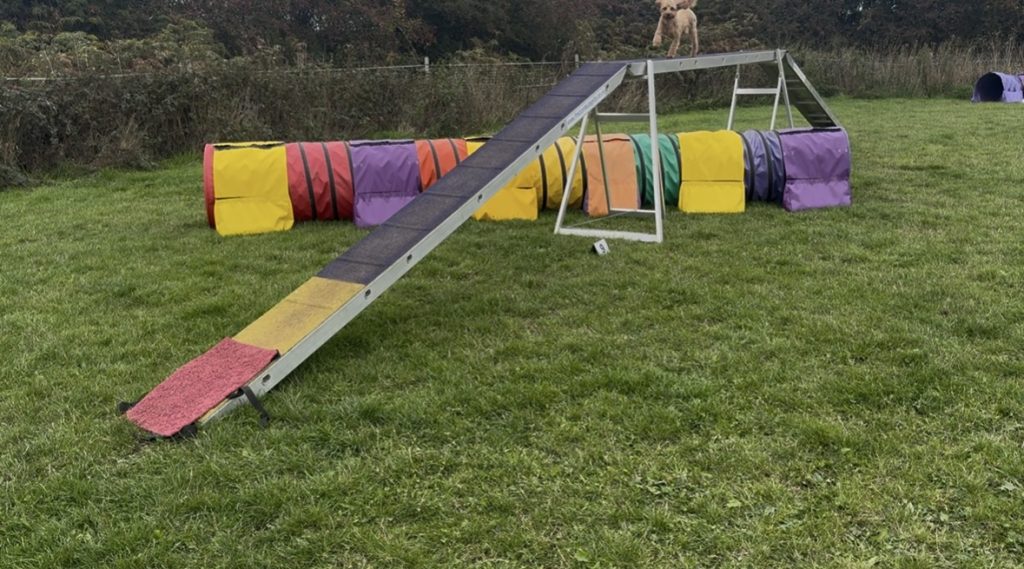
To complete the Dog Walk in Dog Agility, the dog must make visible contact (Dog Agility is judged by eye, so if the judge doesn’t think it was done, it wasn’t. No VAR) with the contact part, which in the photo here is the yellow part of the Dog Walk. For this, we have two options: Running contact or Stop contact. We’ll briefly cover running contacts here. I’m no expert on them yet, as I haven’t had a dog capable of training them, but a running contact is trained by the number of strides. Dogs are trained to take an obstacle in a specific number of strides.
We’ll briefly cover running contacts here. I’m no expert on them yet, as I haven’t had a dog capable of training them, but a running contact is trained by the number of strides. Dogs are trained to take an obstacle in a specific number of strides. This is at least how my trainer describes it. There will be a post on it when I manage them with Ralphie, because to compete at the highest level, you need a reliable and consistent running contact!
So a stop contact. The dog is to drive down the downslope of the obstacle and stop, usually in a down, as it’s much easier on their joints and hold it until they’re released. This is coupled by a ‘target’ command to instruct the dog to run ahead and complete it. They’re significantly easier to train than a running contact and if trained properly, will provide perfect contact every single time.
Where to even Start With a Stop Contact
Me and Bertie are slightly different to the majority of handlers here because we train with a mat – Very appropriate for Bertie if you read on to find out. Let’s talk about how most handlers train this to start. They start with a little saucer or Pringle lid, point to it and when the dog touches it with their nose, reward with a treat on the saucer. Then you create distance and send ons to the mark, but not on any equipment yet. Instead, just in the house or the field. Once you have a reliable ‘target’ to the saucer, you put it at the bottom of the Dog Walk. Now you’ll set your dog up 2 paces up on the downslope with the saucer just at the bottom of the dog walk and give your command. As your dog moves down and completes the move, gradually move your dog further and further back until you’re ready to do the full thing. At this point, start slow. Don’t get your dog full sprinting across; keep them slow and steady and reliable. You’ll use this saucer in every training situation, as there is no point ever not; only remove it in competition and never let it slip.
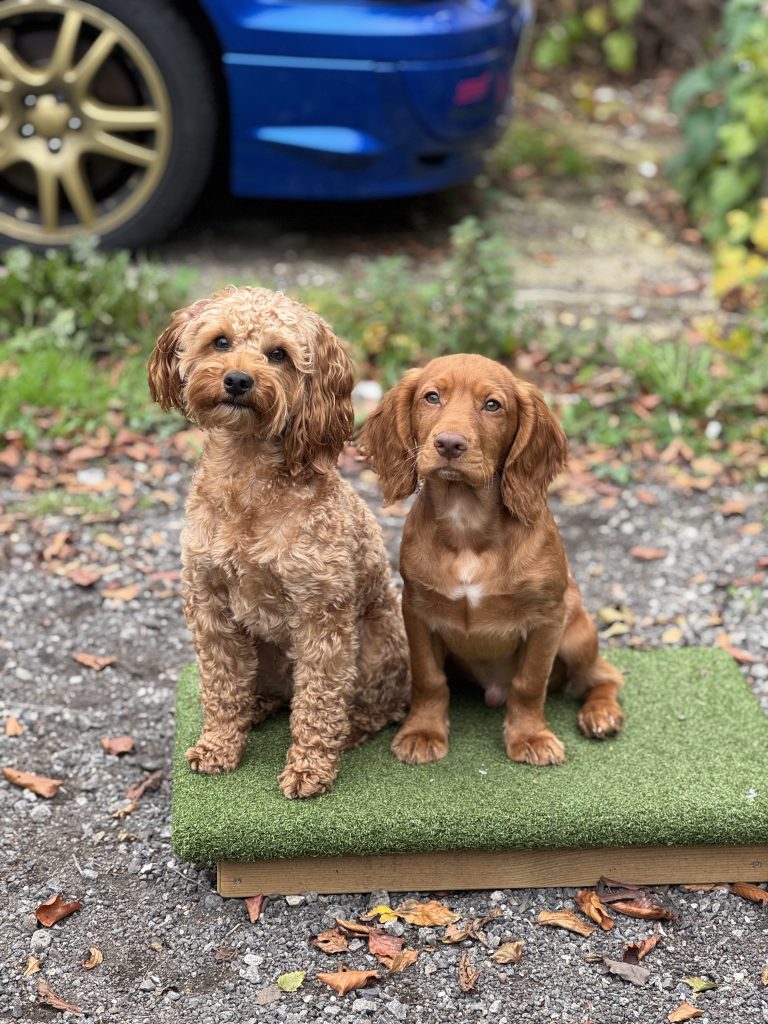
Now onto Bertie’s way of doing it. We have a non-slip ‘contact mat’. The principles are the same and training is the same, just the problem with Bertie is that he isn’t food or ‘dead’ toy-driven whatsoever. If your dog is lower drive like Bertie, here’s how you can still compete in Dog Agility. So, Bertie has a fantastic leave command and I use this to my advantage. Initially, the only way I could get Bertie to drive across the dog walk was by throwing the ball as he’d got to the top and telling him to leave and wait. Then he’s fully focused on the ball and will drive off when released. I integrated my target mat with this, as you can see in the photo here, this is Bertie’s completed contact. Nowadays, he gets a really good contact without the ball or mat. I feel like I’m fairly lucky with how fast he’s picked it up, but that’s not to say we didn’t train really hard at it.
How to train Dog Agility contacts with a Slower, Less Energetic Breed
Here’s the other issue you’ll come into when training lower drive breeds in agility. They’ll tire out and lose interest VERY quickly. When training it with Bertie, I could get about 4/5 drives per session down a contact until he slowed down. I think he finds individual obstacles quite boring to be honest and I mean, he’s not wrong but it’s desperately needed. Retrospectively, my biggest tip here is this: don’t overdo it. Listen to your dog. If you know you’ll only get 5 high drive contacts, take them and use them well. It’s a slow process but they’ll get it eventually. I tried for hours on end to get Bertie to drive more but looking back, you need to make it fun. Your dog will enjoy it eventually and as they enjoy it more, those 5 drives will turn into 10, 20, 30 drives. Bertie now has no issues with contact drive; he’ll run as fast as his little legs will – his energy levels deplete VERY quickly too. There will be a post here on how I manage a Lower Drive, Non-Working Breed’s energy when competing in a Working Dog’s sport.
One day, it all clicked. I began integrating his ball into our reward system. Bertie’s ball drive is next level. Just look at how much he extends when driving for his ball; beyond parallel, it’s fascinating to watch and feel the ground shake when he’s in full sprint. The second we found the right reward, it changed our Dog Agility experience all together. This ball made it into a complete game for him; it made it fun and playful instead of work. Everything to this day is still rewarded with a ball, and he knows it. It’s been fantastic to see how bloody happy he is at training and how loopy he goes over the ball.
Reflection: What Training Stop Contacts with a Low Drive Dog Taught Me
If there’s one thing I’ve learnt from training Bertie, it’s that slower progress doesn’t mean worse progress. Lower drive dogs make you work for every bit of focus and energy, but they also make you pay attention to the little things. I’ve had to learn to stop comparing him to the Border Collies that eat up the course at light speed and just focus on our journey.
Every small improvement feels massive — whether it’s him powering over the dog walk or holding his stop without hesitation. These dogs might not come out the gate flying, but when they finally get it, they really get it.
If you’ve got a dog like Bertie, my best advice is this: don’t chase perfection, chase connection. Drive can be built over time, but trust is what keeps the dog enjoying it and giving you effort even when it’s hard. Bertie’s never going to be the fastest dog out there — but watching him enjoy the work, stay confident, and nail those stop contacts is more rewarding than any rosette. With that being said, Bertie is blood accurate and as I’ve begun managing his energy levels better, he’s faster than ever before. If we can keep going like this, who knows how far we will make it? Never give up and don’t get frustrated. It’ll all pay off one day! Training stop contacts with a lower drive dog has taught me more about patience, focus, and teamwork than any class ever could.